How to Make Pure Water? Comparison of Ion Exchange, RO, and Distillation [Basic Knowledge]
Whether to separate by heat, by membrane, or by exchanging ions. We will compare the three methods based on the materials used, the products obtained, and the differences in components that are challenging to handle.
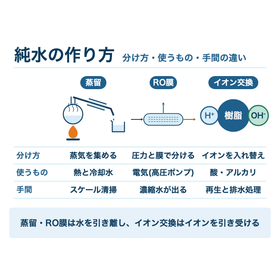
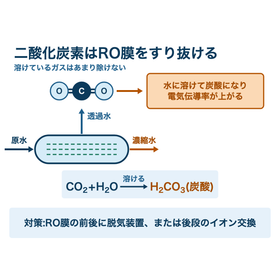
The main methods for producing pure water include distillation, RO membranes (reverse osmosis membranes), and ion exchange. All of these methods reduce impurities in water, but since the principles of separation differ, the required energy, chemicals, operational effort, and byproducts from the equipment also vary. Here, we will compare them by focusing on "what they use and what they produce." ■ What do the three methods use for separation? 1. Distillation: Collects only the steam generated by boiling and condenses it. 2. RO membrane: Uses pressure to separate water that passes through the membrane from components that do not. 3. Ion exchange: Replaces ions in the water with hydrogen ions or hydroxide ions from the resin. The difference is that distillation and RO membranes separate water from impurities, while ion exchange allows the resin to take on the ions that are the impurities. ■ Are there components that each method struggles with? RO membranes have difficulty removing dissolved gases, and ion exchange cannot remove organic matter, fine particles, or bacteria. Distillation also has components that it cannot remove on its own. Therefore, in factories, it is common to combine multiple methods according to the desired water quality. Please feel free to consult with us first.
- Company:トリイ
- Price:Other